GLOBAL

Acoustic Office Interiors — Natural Materials That Work

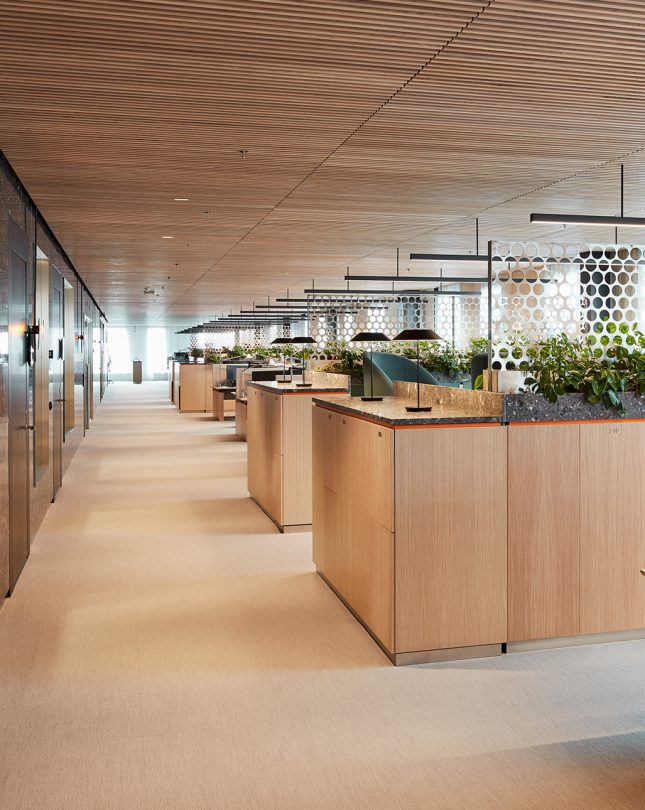
Open-plan offices are acoustically one of the most demanding environments an architect faces. Hard ceilings, glass partitions, hard floors and a high density of people create long reverberation times and elevated background noise – regardless of how considered the layout is. The answer is not to cover every surface in grey foam tiles. It is to specify materials that absorb sound, diffuse reflections and create an interior worth spending time in. Gustafs panels, linear cladding and Feltfon felt offer acoustic performance matched with the warmth of natural materials – for ceilings, walls and everything in between.

In this page you can find:

• Why open plan offices fail acoustically >>
• How sound adoption works >>
• Start with the ceiling >>
• Then consider the walls >>
• Materials and proucts for office interiors >>

+

What is office acoustics?

Office acoustics refers to how sound behaves in a workspace. It affects speech clarity, noise levels, and the ability to concentrate.

In open-plan offices, hard surfaces and large volumes often lead to high noise levels and poor speech privacy. Without proper acoustic treatment, this directly impacts both productivity and employee wellbeing.

+

Common acoustic challenges in offices

High noise levels in open-plan environments

  • Lack of speech privacy in meeting areas
  • High noise levels in open-plan environments
  • Lack of speech privacy in meeting areas
  • Sound reflections from glass, concrete, and hard surfaces
  • Distractions that reduce focus and efficiency

These challenges require more than standard solutions – they demand integrated acoustic design.

THE PROBLEM

Why open-plan offices fail acoustically

Why is our office so noisy even with acoustic panels?

Most offices are designed for visual openness. The result is a room with large, hard, parallel surfaces – concrete ceilings, glass walls, hard floors – that reflect sound back and forth across the space. Every conversation competes with every other, background noise rises, and the space becomes exhausting to work in.

Adding a few acoustic tiles to one wall does not solve it. Effective acoustic design in an office requires treating the right surfaces in the right way – and understanding the difference between absorption, which shortens reverberation, and diffusion, which scatters reflections to create a more even, comfortable sound environment.

Both are needed. Neither alone is enough.


Read More:

Effective office acoustics requires a balance between sound absorption, spatial design, and material selection. Learn how different strategies impact performance and how to apply them in real projects>>

Read more in our Knowledhe Hub

FIVE PRINCIPLES OF ACOUSTICS

THE IMPACT OF SOUND

Several ways to achieve sound absorption

Sound absorption can be achieved in different ways – and the right approach depends on your acoustic target, available installation depth and the aesthetic you want to achieve. Gustafs products cover all four mechanisms.

Perforation holes

Sound enters through the holes, resonates in the void behind and is converted to heat. Effective at mid frequencies. The deeper the void and the more insulation behind, the better the result. A visible perforation pattern on the surface.

Nano perforation

300,000 holes per square metre at 0.5 mm diameter, invisible to the naked eye. Sound is converted to heat directly in the holes themselves, without requiring a void behind. Less dependent on installation depth than standard perforation.

Spacing

The same principle as perforation, but the gaps between products act as the entry point. The wider the spacing and the deeper the void, the greater the absorption.

Felt material

Sound passes through the fibrous felt and is absorbed directly. Performance depends on the construction – the combination of felt and an integrated air void delivers significantly higher absorption than felt installed flat against a surface.

AIR & VOID MATTERS

The installation depth matters

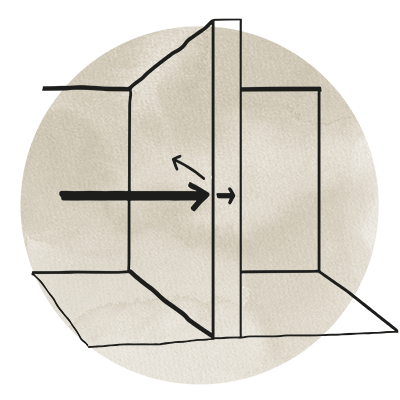
The acoustic specification is a system decision, not just a product choice. For all Gustafs acoustic products, the complete installation determines the acoustic result – not just the product itself. The same material can deliver absorption class D installed directly against the surface, or class A when combined with the right construction depth and insulation behind it.


Direct installation – no void, no insulation. Absorption class D.

Air void – a gap between the product and the structural surface improves absorption. An air void needs to be approximately twice as deep as insulation to achieve a comparable result.

Mineral wool insulation – the most efficient approach. Broader frequency range and higher absorption class at a shallower depth than an air void alone.

Insulation plus air void – the highest performance. Broadens the frequency range further and raises absorption to its maximum for the product.

The acoustic specification is a system decision, not just a product choice.


STEP 1. THE CEILING

Start with the ceiling

What type of acoustic ceiling works best in an open-plan office?

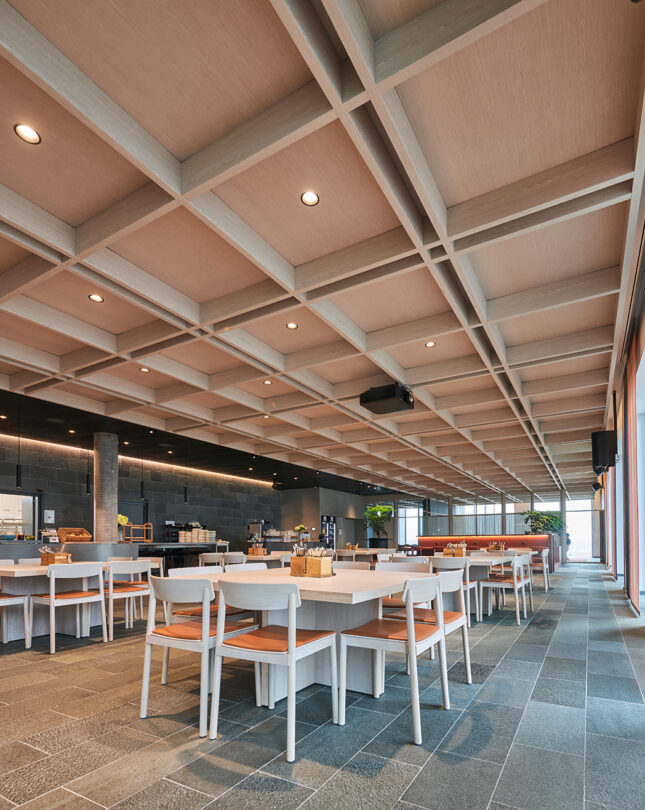
The ceiling is the single largest untreated surface in most offices and the first priority for acoustic improvement. It is also the surface with the most design potential – a well-specified acoustic ceiling can define the character of an entire floor.


How much absorption do you need?

The target reverberation time for a standard open-plan office is approximately 0.4–0.6 seconds. A bare concrete or plasterboard ceiling typically produces reverberation times of 1.0-1.5 seconds or more. The gap between those two numbers is what your ceiling specification needs to close.

The depth of the acoustic void or insulation behind the ceiling surface has a significant influence on the result – deeper voids absorb lower frequencies more effectively. Gustafs Nano Panels are an exception: because of the way Nano technology works, they require less depth behind them to achieve comparable absorption.


The product table below shows which Gustafs products work for ceilings – and which also work on walls.

STEP 2. THE WALLS

Then consider the walls

Do I need acoustic panels on walls as well as the ceiling in an office?

In large open floors, ceiling treatment alone may not be sufficient. Side reflections from walls, partitions and glazed facades contribute to noise levels and acoustic discomfort — particularly near collaboration zones, kitchens and glass facades.

Walls are also the most visible surface in an interior. The opportunity to combine acoustic function with a strong material statement is at its greatest here.

Prioritise walls that face high-activity zones first. A single treated wall opposite a glass facade can significantly reduce the flutter echo that makes large offices feel hard and loud.

Read more about how well-balanced room acoustics can have multiple health benefits


Read more in our Knowledhe Hub

OPTIMAL COMBINATION OF ABSORBTION & REFLECTION


STEP 3. MATERIAL

Choose your material

What is the difference between acoustic wood panels, linear cladding and felt panels for offices?

Most Gustafs products can be used on both ceilings and walls – the difference lies in the installation system and edge profiles, not the product itself.

The guide below shows where each product family performs best.

WOOD

Wood
Perforated panels

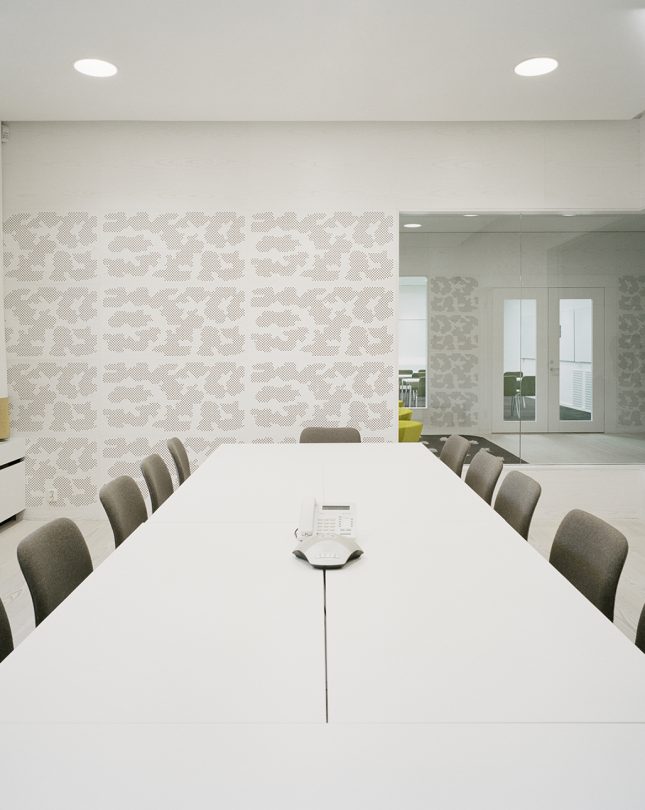
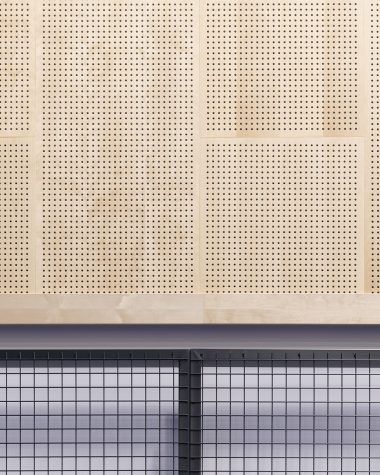
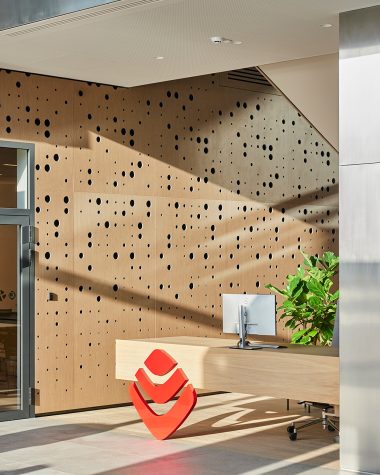
A full wood-veneer face with acoustic absorption behind it. The perforation pattern is visible at close range but reads as a natural part of the wood surface at normal distances. Several patterns available – round holes, circular arrangements and rectangular slots – acoustic class up to A. A2-s1,d0 with fibre-gypsum core.

APPLICATION: Ceiling & Wall

FELT

Felt
highest absorption

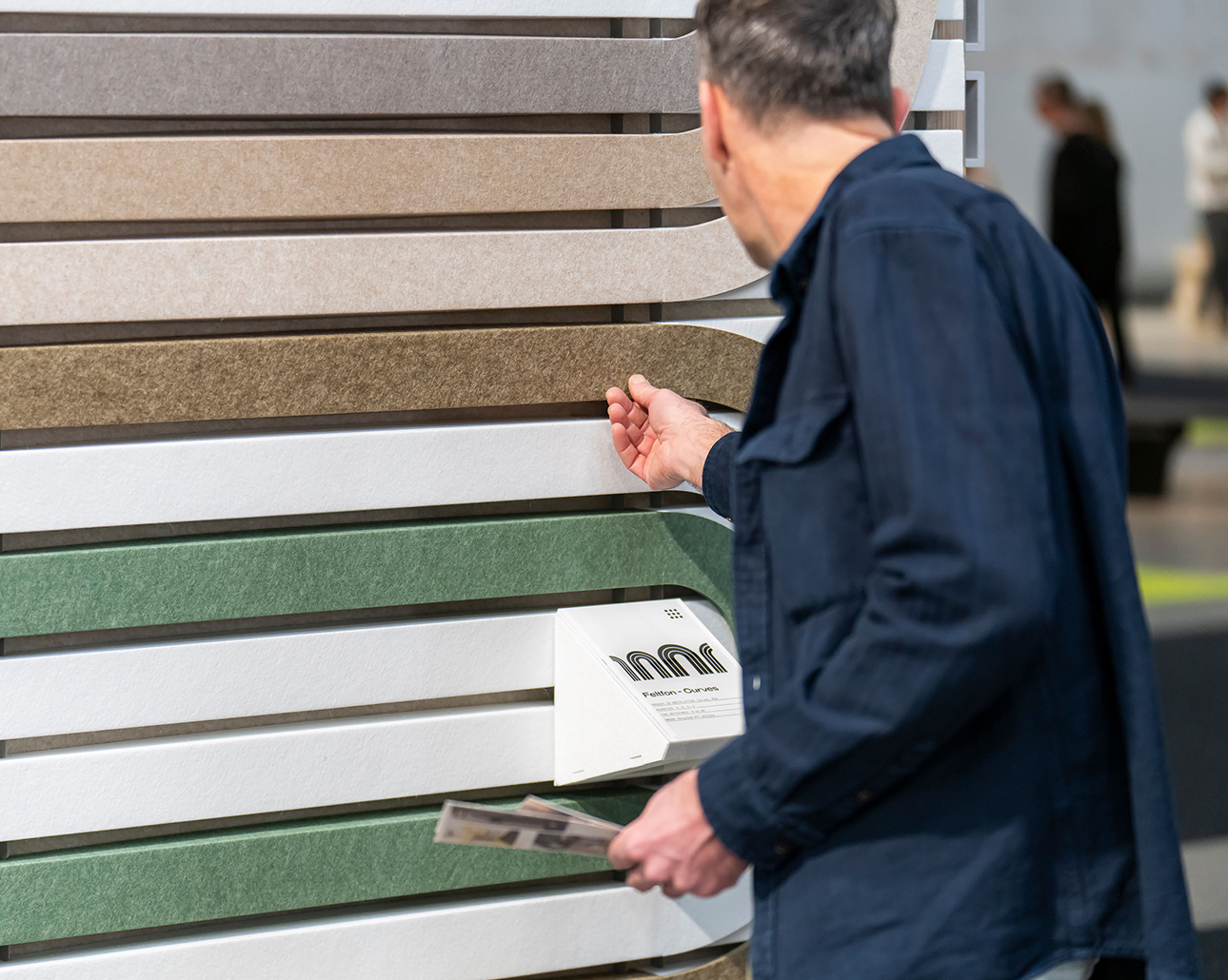
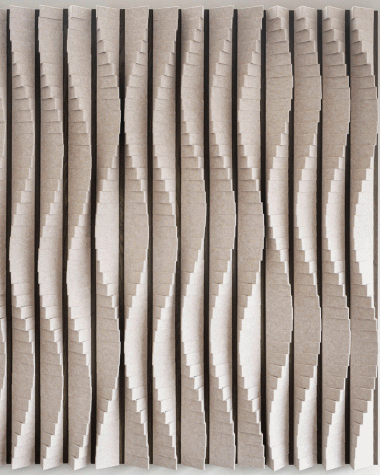
Feltfon absorbs sound directly from its recycled PET surface — no perforation required. Feltfon products have a built-in void as part of their construction – it is this combination of felt material and integrated air space that delivers absorption class A.

Available in a wide range of colours and forms.

APPLICATION: Ceiling & Wall

WOOD

Wood
Blayde baffles

Deep vertical baffles (130–400 mm) in real wood veneer. Creates a dramatic three-dimensional surface with strong acoustic absorption and diffusion. Particularly effective in high ceilings and as a feature wall. Part of the Linear Mix system. Acoustic class depends on depth, spacing and surface – with Nano perforation and Feltfon backing, class A is achievable

APPLICATION: Ceiling

WOOD

Wood
Linear Ribs

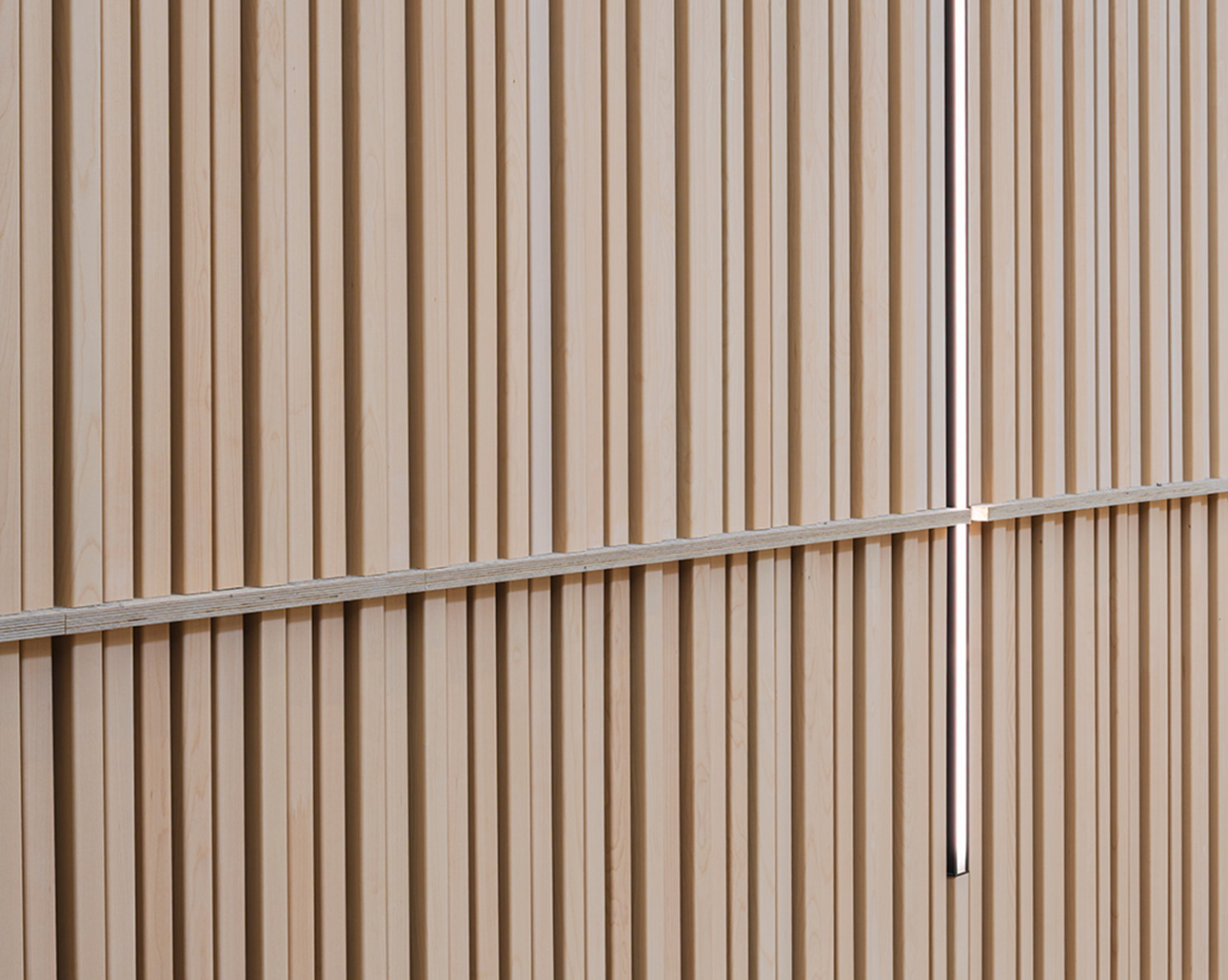
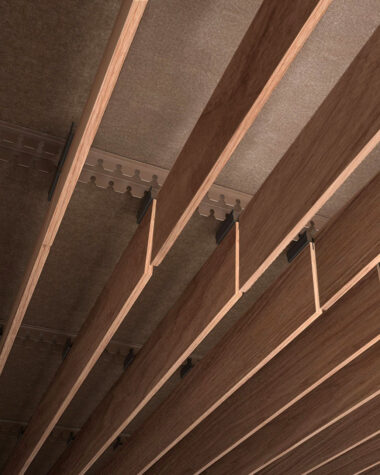
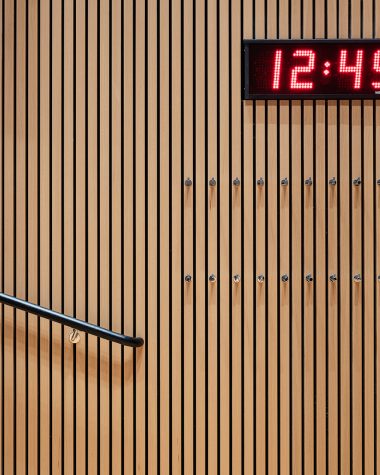
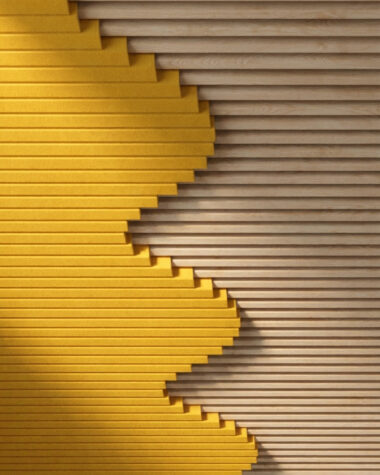
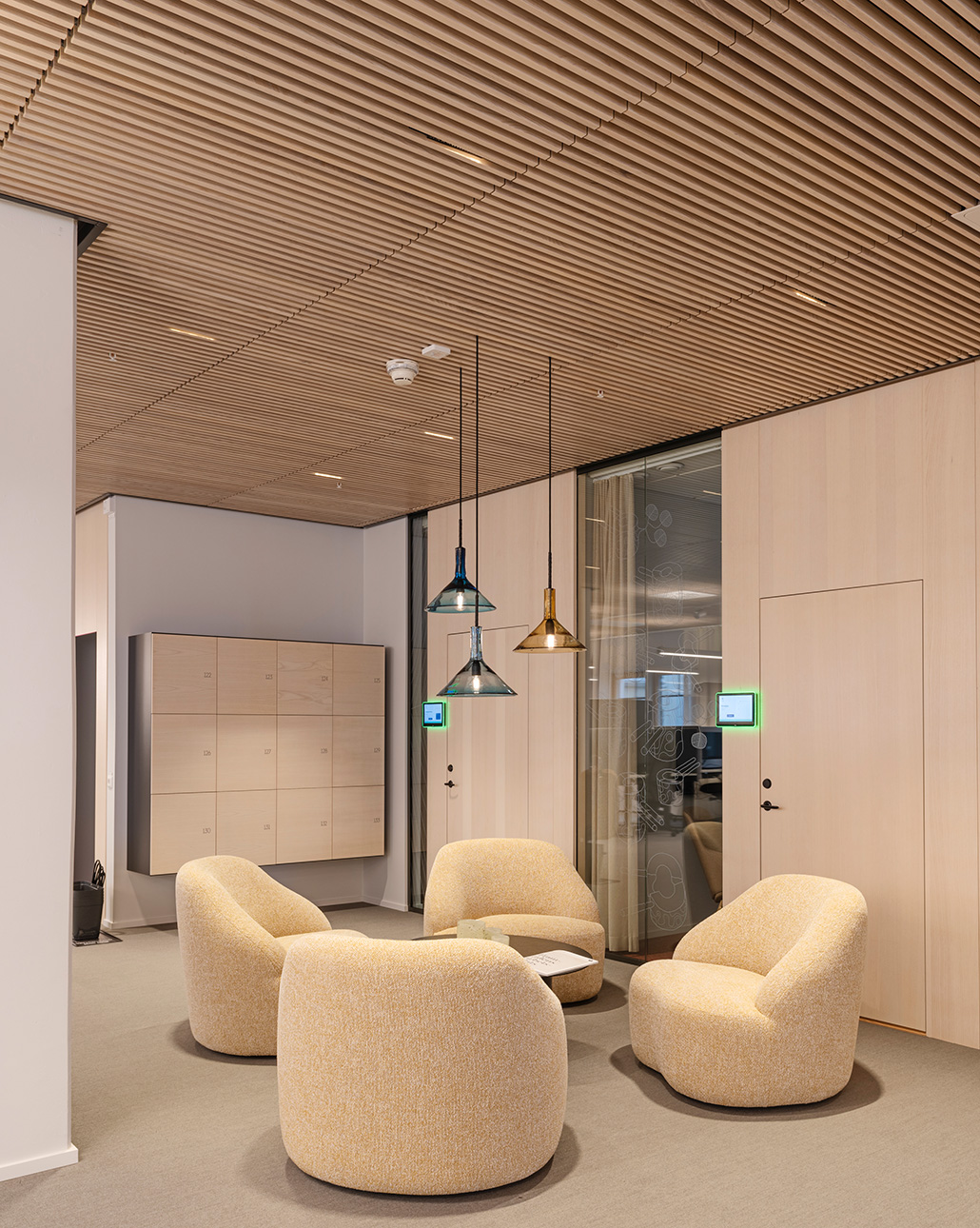
A linear wood expression with acoustic absorption through the spacing between ribs. The wider the spacing and the deeper the void, the greater the absorption. The fibre-gypsum core also provides diffusion. Available in four profile shapes – Rib-R (rounded), Rib-S (sharp), Rib-E (fully rounded) and Narrow (22 mm).

APPLICATION: Ceiling + wall.

WOOD & FELT

The complete system
Linear Mix

The most flexible option. Combines wood Linear Ribs, Feltfon elements, Blayde baffles and integrated F-Line LED lighting within a single Capax installation framework. The architect controls the ratio of absorption to diffusion zone by zone, without changing the installation system.

APPLICATION: Ceiling. Individual components also available for walls.

WOOD

Wood
Nano perforation

300,000 holes per square metre, each 0.5 mm – invisible to the naked eye. The wall or ceiling reads as solid wood. Comparable acoustic performance to standard perforation, with shallower installation depth.

APPLICATION: Ceiling + wall.

WOOD

Wood
Modules

Solid wood modules for walls and ceilings where a more artisan, tactile expression is the priority. The open structure between the modules provides acoustic absorption, with the level depending on void depth and insulation behind. Available in three versions depending on application.

Module Wall – Wall
Module FS-Ceiling – Ceiling, fixed
Module T24 Ceiling – Ceiling, suspended and demountable

WOOD & FELT

Wood and felt combined

Products that integrate real wood veneer and recycled PET felt in a single panel – material contrast and acoustic function in one.

Lamellow+ – wood veneered slats on felt backing. Acoustic class A with insulation. Ceiling + wall.
Lamellow+ Cera – Laquered fibregypsum linear ribs with felt backing. Acoustic class A with insulation.
Lamellow Spa – adapted for humid environments and outdoor use. Ceiling + wall.
Figura+ – nature-inspired milled patterns (Bubbles, Splash, Snake, Pebbles) with integrated felt backing. Ceiling + Wall

Gustafs acoustic products – walls and ceilings

Which Gustafs product is right for my office project?

Every product in the Gustafs range can be used on walls, ceilings or both – the difference lies in the installation system, not the product itself. The table below gives you a direct overview of where each product can be used, what acoustic class it can achieve and whether the result depends on installation depth and insulation behind it.

Product Wall Ceiling Acoustic class Depends on installation
Felt – Feltfon
Feltfon Linear Rib
rPET felt, linear design
xxABuilt-in void in product
Feltfon Baffles xxABuilt-in void in product
Feltfon Diabolo / Curves / Pixel / DNA
3D shapes
xxABuilt-in void in product
Feltfon Slash / Intersections / Layers
Vector designs
xxABuilt-in void in product
Feltfon Amethyst / Blox / Diamond
Jewel designs
xxABuilt-in void in product
Feltfon AddStyle
Clips onto existing soft ceiling
xA, B, CDepends on installation
Wood panels – perforated
Perforated panels xxA, B, DYes – void + insulation
Nano Panels
0.5 mm holes, invisible
xxB, DYes – less dependent than standard
Wood – Linear Ribs
Rib-R / Rib-S / Rib-E / Rib Narrow
Fibre-gypsum core
xxA, B, C, DYes – spacing + void + insulation
Blayde baffles
130-400 mm depth
xA, B, C, DYes depth + spacing + surface + backing
Wood – Linear Plank
Linear Plank Wall / Linear Plank Ceiling xxDNo
Linear Plank-P Wall / Linear Plank-P Ceiling
Perforated, A2-s1,d0
xxDYes – void + insulation
Wood – Module
Module Wall xB, DYes – void + insulation
Module FS-Ceiling / Module T24
T24 is demountable
xB, DYes – void + insulation
Wood fibre gypsum and felt combined
Lamellow+ / Lamellow+ Cera
Wood slats + felt strips
xxA, DYes – insulation behind
Lamellow Spa
Humid + outdoor
xxA, DYes – insulation behind
Figura+
Nature-inspired patterns + felt
xA, B, CYes – insulation behind
Complete system
Linear Mix
Ribs + Feltfon + Blayde + F-Line LED
xA, B, C, DYes – depends on components chosen

Read more

Gustafs sound absorbers
Products and absorbtion
Gustafs Acoustic values
Full acoustic values for products

CASE STUDIES

Proven in real office projects

OFFICE PROJECT

Arbor, London

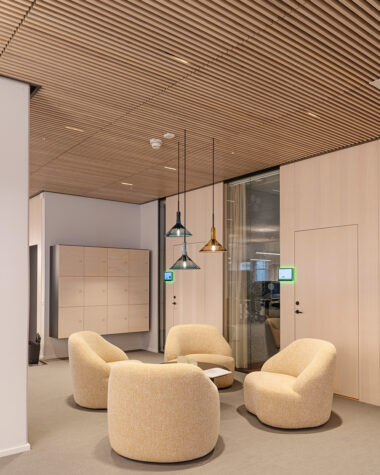
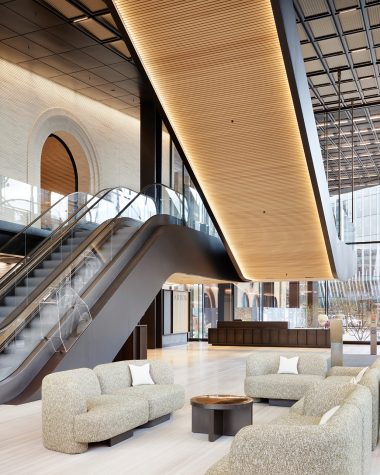
300 sqm of Gustafs Linear Rib in the entrance area of a central London office building designed for long-term flexibility. A project where the acoustic and aesthetic brief were treated as one.

Architects: PLP Architecture – Myles Burke

OFFICE PROJECT

Cisco Webex Room Panorama

Red Dot Best of Best 2020
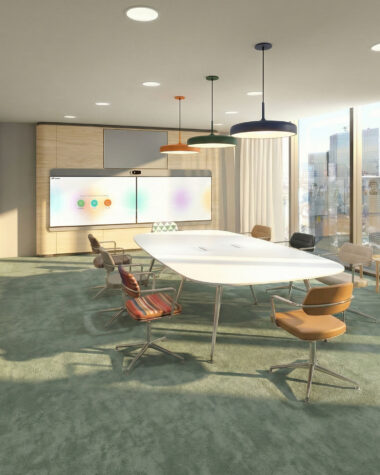
Gustafs panels in a purpose-built video conferencing environment where acoustic precision is the entire point. Awarded Red Dot Best of Best – one of the most recognised design awards in the world.

OFFICE PROJECT

KGC Office, Vilnius

Architects: DVI Interior Design

Wellbeing and sustainability as the brief – Gustafs panels throughout a premium workspace in Lithuania. Architect interview available on the site.

OFFICE PROJECT

Fora, London

Gustafs panels demounted from a previous installation and given new life in a London workspace. A case study in circular material use – and a strong argument for specifying Gustafs from the start.


DOWNLOADS

Ready to specify your acoustic office interior?

Whether you are at concept stage or preparing a full specification, we can support you with acoustic data, product samples and project-specific guidance.


ORDER ACOUSTIC SAMPLES
DOWNLOAD ACOUSTIC DATA
FIND YOUR LOCAL REPRESENTATIVE

FIND THE RIGHT SOLUTION FOR FIRESAFETY


Frequently asked questions

What is a good reverberation time for an open-plan office?

The recommended reverberation time for a standard open-plan office is 0.4-0.6 seconds at mid-frequencies (500-1,000 Hz). Spaces above 0.8 seconds are typically perceived as noisy. Meeting rooms and focus areas benefit from 0.3-0.5 seconds. Gustafs provides alpha-values for all products to support acoustic calculations.

What is the difference between acoustic wood panels and felt panels for offices?

Wood panels provide a combination of diffusion (scattering of reflections) and absorption when perforated or when spacing is used between linear elements. Felt panels provide higher direct absorption with minimal diffusion. Most well-specified offices benefit from both – wood for its diffusive quality and natural warmth, felt for targeted absorption in high-noise zones. Gustafs Linear Mix allows both to be combined within a single ceiling installation system.

Do acoustic ceiling panels work without insulation behind them?

It depends on the product. Gustafs Feltfon and Nano Panels absorb sound directly without requiring insulation or a void. Standard perforated panels and Linear Ribs work best with mineral wool insulation behind. An air void can substitute for insulation but approximately twice the depth is required to achieve a comparable result.

Can acoustic panels be combined with integrated lighting?

Yes. Gustafs F-Line LED is designed for seamless integration within the Linear Mix ceiling system, combining acoustic performance and lighting in a single linear element. The luminaire is fully compatible with Linear Ribs and Feltfon elements, sharing the same Capax mounting principle. No separate ceiling penetrations or independent lighting tracks are required.

What fire classification do acoustic panels need in a commercial office?

For standard commercial offices, B-s1,d0 is typically sufficient. This is achieved by Gustafs Feltfon, Linear Ribs and panels with fire-retardant improved substrates. If the building is above 18 metres or in a regulated occupancy, Gustafs Panel System and Linear Plank-P with fibre-gypsum core achieve A2-s1,d0. See our Fire Safety solutions page for full guidance.

Can Gustafs panels be demounted when we move office?

Yes. All Gustafs solutions are available in fully demountable versions using the Capax system. Panels can be removed individually, stored and reinstalled in a new location. The investment in the material follows the tenant, not the building.

How do I combine wood and felt in the same ceiling?

The Gustafs Linear Mix system is designed exactly for this. Wood Linear Ribs, Feltfon elements, Blayde baffles and F-Line LED all share the same Capax Mix mounting principle – they align perfectly and install within the same framework. The designer controls the ratio of materials zone by zone without changing the installation system or the structural depth.

What is the shallowest acoustic ceiling solution available?

Gustafs Nano Panels offer the shallowest installation depth of any acoustic Gustafs product. Because Nano technology transforms sound into heat energy at the point of entry, less depth is required behind the panel. For retrofits where depth is constrained, Feltfon AddStyle clips directly onto an existing soft ceiling without any additional substructure.

How many square metres of acoustic treatment do I need for my office?

As a starting point, treating 20-30% of the total ceiling area with a high-absorption product such as Feltfon typically brings a standard open-plan office within the target reverberation time range. An acoustician can model the specific requirements using the alpha-values Gustafs provides for all products.

MORE FAQ

Generic filters
Exact matches only
Search in title
Search in content
Search in excerpt