 GLOBAL


This guide is for architects, acousticians and school project managers.
This guide explains how to approach specification in educational environments – from acoustic targets and fire requirements to material choices – and which Gustafs solutions support each.
Go to: Why acoustics matter in learning environments Fire safety requirements in schools Biophilic design and student performance Room-by-room acoustic specification Recommended products & solutions
THE PROBLEM
Why learning environments are acoustically demanding
Why is it so hard to create good acoustics in a school?
Classrooms, lecture halls, libraries and corridors each have different acoustic needs – and each fails in a different way when those needs are not addressed. Hard surfaces, high ceilings and hard floors create reverberation that makes speech difficult to understand. Background noise from adjacent rooms, ventilation and activity outside bleeds into teaching spaces. In open-plan learning areas, the problem is compounded further.
Research consistently shows that poor acoustics in classrooms directly affects learning outcomes – particularly for younger children, non-native speakers and students with hearing difficulties or neurodiverse conditions. A reverberation time of 0.4-0.6 seconds is typically recommended for primary school classrooms. Lecture theatres and music rooms have different targets. Libraries need the quietest environments of all.
The acoustic brief is not one specification – it is a series of room-by-room decisions.
FIRE SAFETY
Fire classification in educational buildings
What fire classification do I need for a school or university?
Educational buildings are regulated occupancies. In the UK, Building Regulations Part B and BS 9999 require A2-s1,d0 or better for walls and ceilings in most areas of schools and universities – particularly corridors, stairs and any space where evacuation is complex. Across the EU, national building codes based on EN 13501-1 apply similar requirements. The principle is consistent: in buildings where occupants may need time to evacuate, materials that do not contribute to fire development are required.
This is what rules out most standard wood products. And it is what Gustafs was built to solve.
All Gustafs Panel System products, Linear Ribs, Blayde baffles and Linear Mix achieve A2-s1,d0 through the composition of the fibre-gypsum core – not through chemical treatment. The classification applies to the complete installed system and does not degrade over the lifetime of the building.
Key regulatory standards for educational acoustics
Acoustic performance in educational buildings is governed by mandatory standards and certification schemes that vary by country. The table below gives a practical overview. Gustafs provides alpha-values, fire classification documentation and Declaration of Performance for all products to support compliance verification in any jurisdiction.
| Region | Standard | Scope | Notes for specification |
|---|---|---|---|
| UK | BB93 – Acoustic Design of Schools Building Regulations Part E |
All schools, mandatory | Specifies maximum reverberation times and minimum sound insulation per room type. BREEAM credits linked to BB93 compliance, verified by on-site testing. |
| Sweden | Boverkets Byggregler (BBR) SS 25268 |
All schools, mandatory | SS 25268 sets reverberation time targets for educational spaces. BBR sets minimum requirements for sound insulation between rooms. |
| Denmark | BR18 Building Regulations (BR18) |
All schools, mandatory | BR18 sets mandatory acoustic requirements for schools directly, without a voluntary classification scheme. Reverberation time targets are applied via associated guidance and industry practice. |
| EU broadly | EN ISO 3382-1 National codes per country |
Schools and universities | EN ISO 3382-1 defines measurement methods for reverberation time. National building codes set the performance targets – these vary significantly by country. |
| USA | ANSI/ASA S12.60 | Schools, voluntary but widely adopted | Sets maximum background noise levels and reverberation times for classrooms. Widely referenced in public school procurement. LEED credits available for compliance. |
| Global certification | BREEAM / LEED / WELL | Credits for acoustic performance | All three schemes award credits for acoustic design in educational buildings. Gustafs products comply with BREEAM, LEED, BVB and Svanen requirements. EPD documentation available on request. |
For project-specific documentation including acoustic values, Declaration of Performance and fire classification certificates, contact your local Gustafs representative or download acoustic values directly.

HIGH PERFORMANCE
What defines high-performing learning environments
Biophilic design in learning environments
Does biophilic design actually improve learning outcomes?
Access to natural materials, daylight and views of nature has a measurable impact on learning. Studies show improved concentration, reduced stress and enhanced cognitive performance in students. Classroom design alone can account for up to 16% of variation in academic progress.
Wood is the most practical way to introduce these qualities in interior environments. It creates warmth and variation while remaining predictable, durable and suitable for large-scale applications. When combined with acoustic performance and certified fire safety, it meets both architectural and regulatory demands.
Designing for inclusion – acoustic equity in education
Acoustic conditions directly affect learning outcomes, but not equally. Students with hearing impairments, ADHD or language challenges are significantly more affected by poor speech intelligibility and high noise levels.
This makes acoustics a matter of accessibility and compliance, not just comfort. Standards such as BB93 set clear targets for reverberation and speech clarity in schools.
Gustafs panels are engineered to deliver verified acoustic performance. Alpha values are available for different installation depths, enabling accurate specification and compliance in each individual space.
Room by room – how to approach the specification
How do I specify acoustic panels for different types of learning space?
Classrooms
Speech intelligibility above all
The teacher’s voice must reach the back of the room clearly. Ceiling treatment is the first priority, followed by the wall opposite the teaching wall. Hard parallel surfaces and flutter echo are the most common acoustic failures in school classrooms.
Acoustic target
0.4 – 0.6 s
Reverberation time at mid-frequencies. Per BB93 / EN ISO 3382-2.
Fire class required
A2-s1,d0
Walls and ceilings. UK Building Regs Part B and EU EN 13501-1.
Recommended products
Gustafs provides alpha-values at multiple installation depths for all products — allowing acousticians to verify compliance for each specific room configuration.
Corridors & circulation
Highest fire classification, acoustic and biophilic function combined
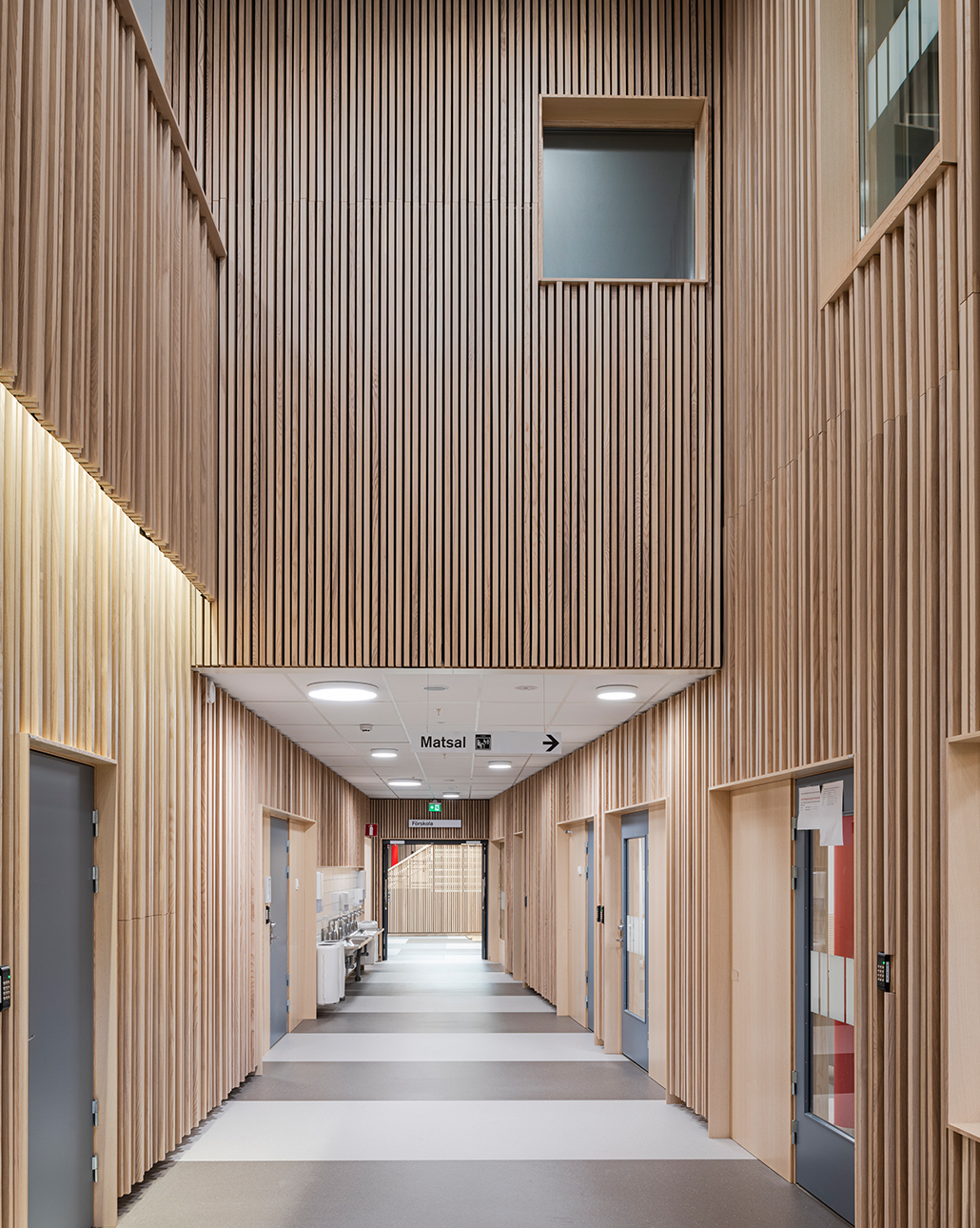
High foot traffic, hard floors and hard walls create challenging acoustic environments. As primary evacuation routes, corridors require the strictest fire classification in most jurisdictions. Wall panels serve a dual function: acoustic treatment and biophilic design in the spaces students move through most.
Acoustic target
Reduce RT + noise
No fixed target. Aim for absorption class A on upper walls and ceiling to reduce noise bleed into adjacent classrooms.
Fire class required
A2-s1,d0
Primary evacuation route. Strictest classification required in most jurisdictions.
Recommended products
Gustafs Panel System and Linear Ribs achieve A2-s1,d0 through fibre-gypsum core composition — not chemical fire retardants. The classification does not degrade over the lifetime of the building.
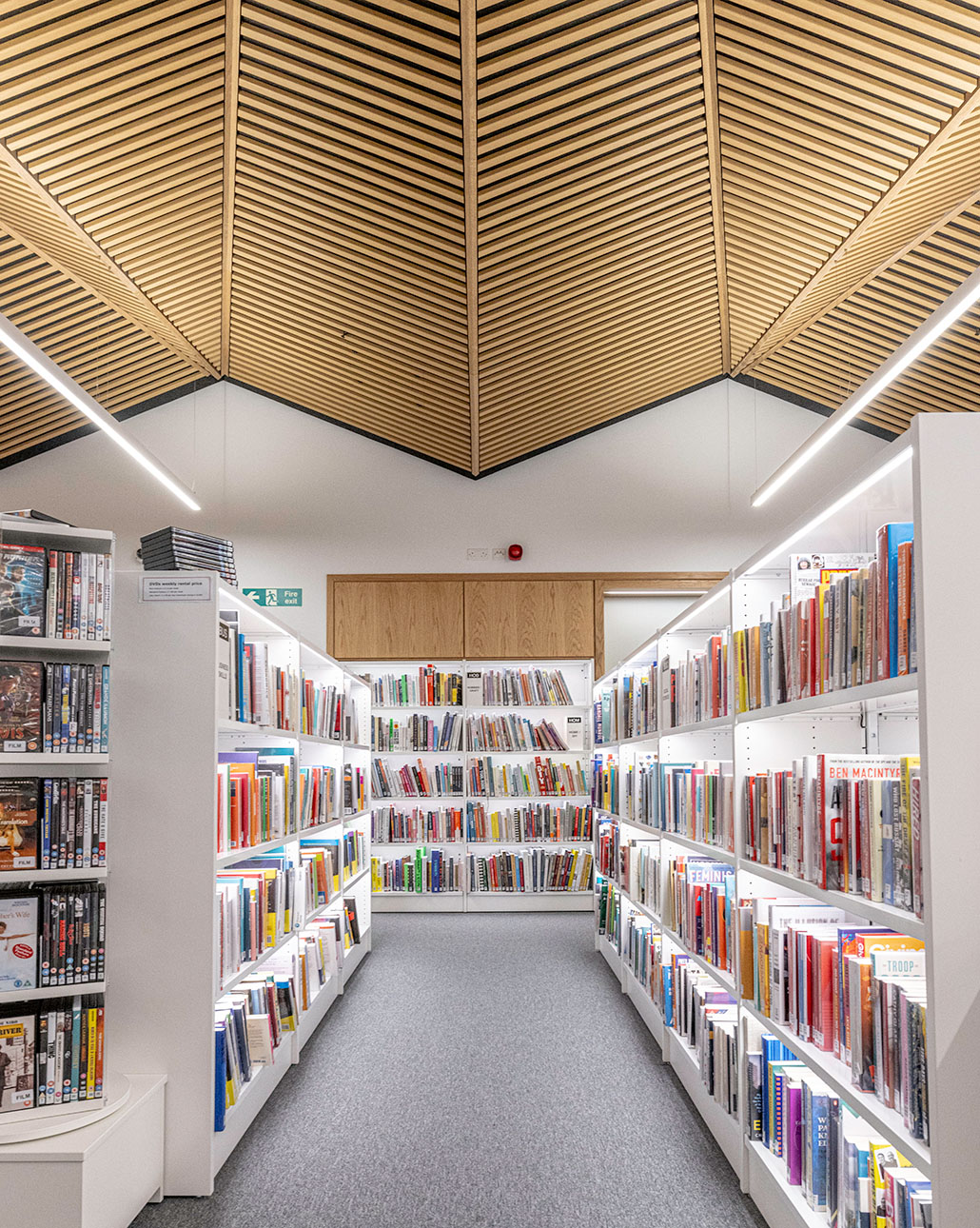
Libraries & study spaces
Maximum absorption — without acoustic deadness
The quietest spaces in any educational building require the highest absorption. Too much absorption makes a room feel acoustically dead, so wood panels on feature walls provide controlled diffusion. Felt on the ceiling is the most efficient first treatment.
Acoustic target
< 0.4 s
Low reverberation for concentrated study. Absorption class A ceiling treatment is the priority.
Fire class required
B-s1,d0 or A2
Varies by floor, occupancy and national code. Confirm with Building Control.
Recommended products
Feltfon delivers class A absorption without perforation in the wood surface — preserving the visual warmth of the ceiling while maximising acoustic performance.
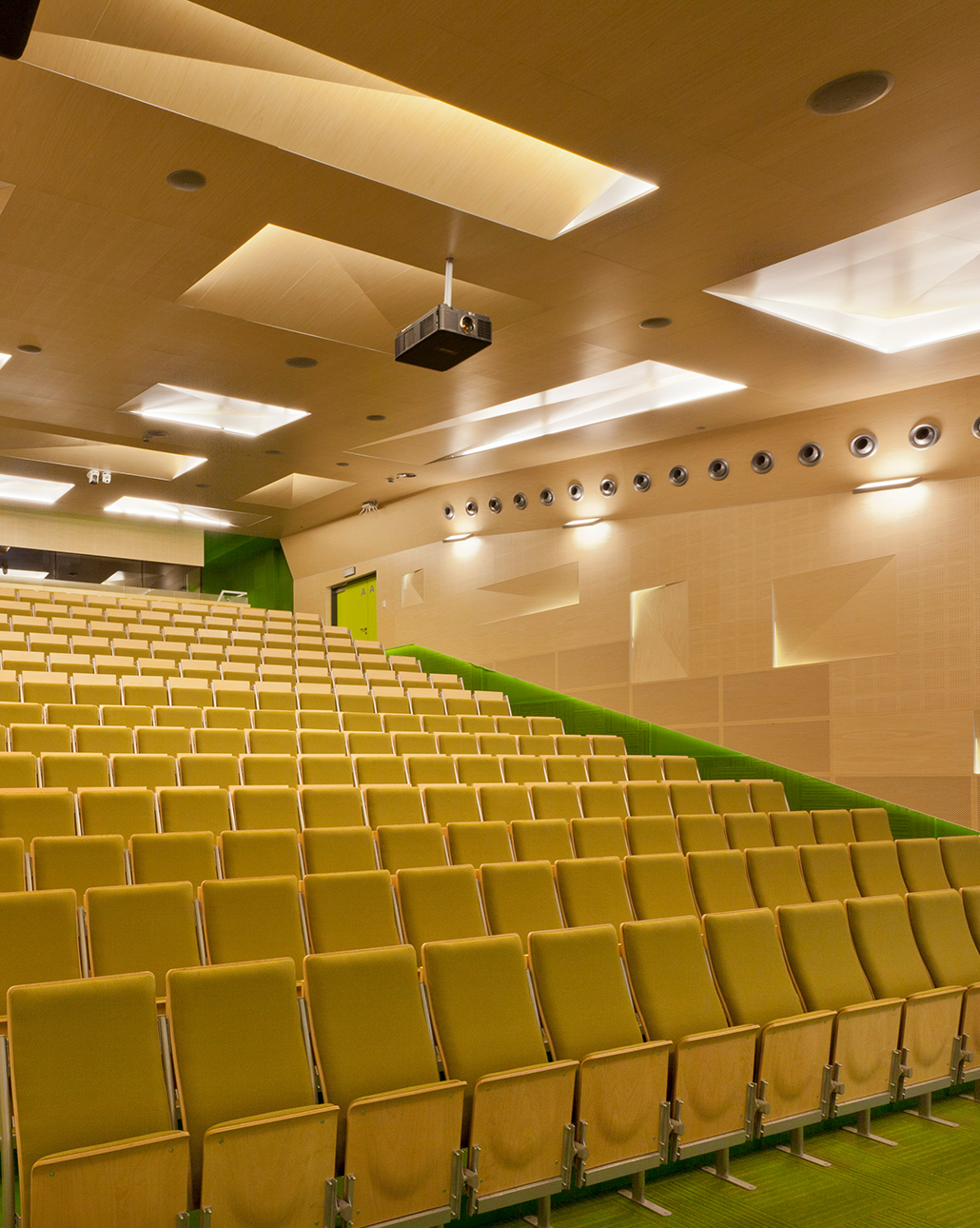
Lecture halls & auditoriums
Absorption and reflection in precise balance
Complex acoustic design requiring a careful balance of absorption and controlled reflection. Reverberation targets vary by hall volume and primary use. Gustafs bespoke panels and Linear Mix allow the architect and acoustician to fine-tune absorption and diffusion zone by zone.
Acoustic target
0.6 – 1.0 s
Varies by volume and use. Specialist acoustician required. Speech and music halls have different targets.
Fire class required
A2-s1,d0
High-occupancy space with complex evacuation. Strictest classification applies throughout.
Recommended products
Linear Mix combines Ribs, Feltfon and Blayde baffles in a single ceiling system — giving the acoustician precise control over absorption and diffusion from a unified product family.
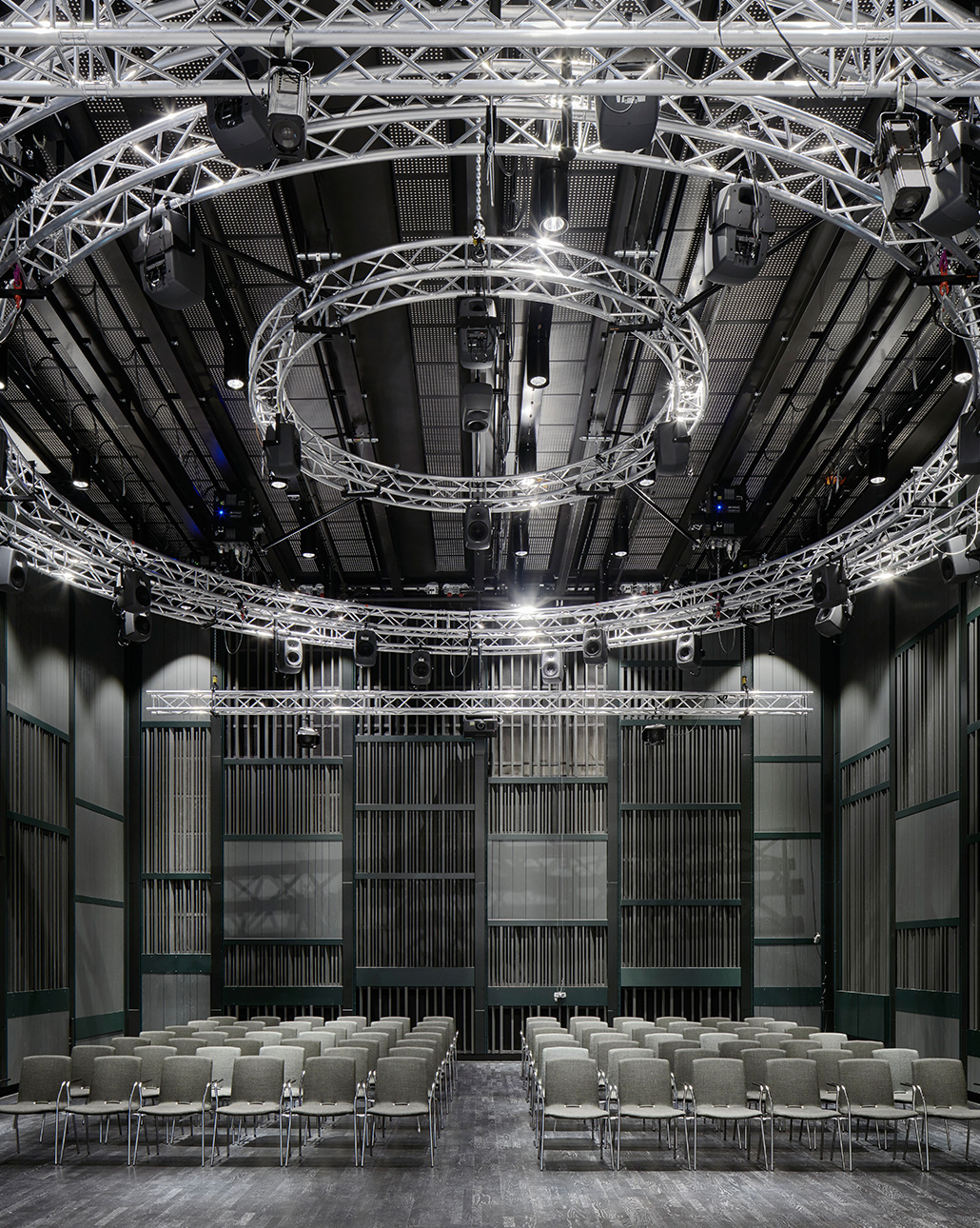
Music rooms & performance spaces
The most demanding acoustic environment in any school
Requires precise control of reverberation, diffusion and reflection — always in consultation with a specialist acoustician. Practice rooms, ensemble spaces and performance halls each have different requirements. Gustafs has been specified at the Royal College of Music in Stockholm.
Acoustic target
Specialist design
No single target. Always involve a specialist acoustician from early in the design process.
Fire class required
A2-s1,d0
High-occupancy performance space. Chemical-free classification through fibre-gypsum core.
Recommended products
At the Royal College of Music, painted ash veneer panels in red, blue and black were each designed for a specific acoustic brief — demonstrating how Gustafs bespoke panels can satisfy both aesthetic and acoustic requirements simultaneously.
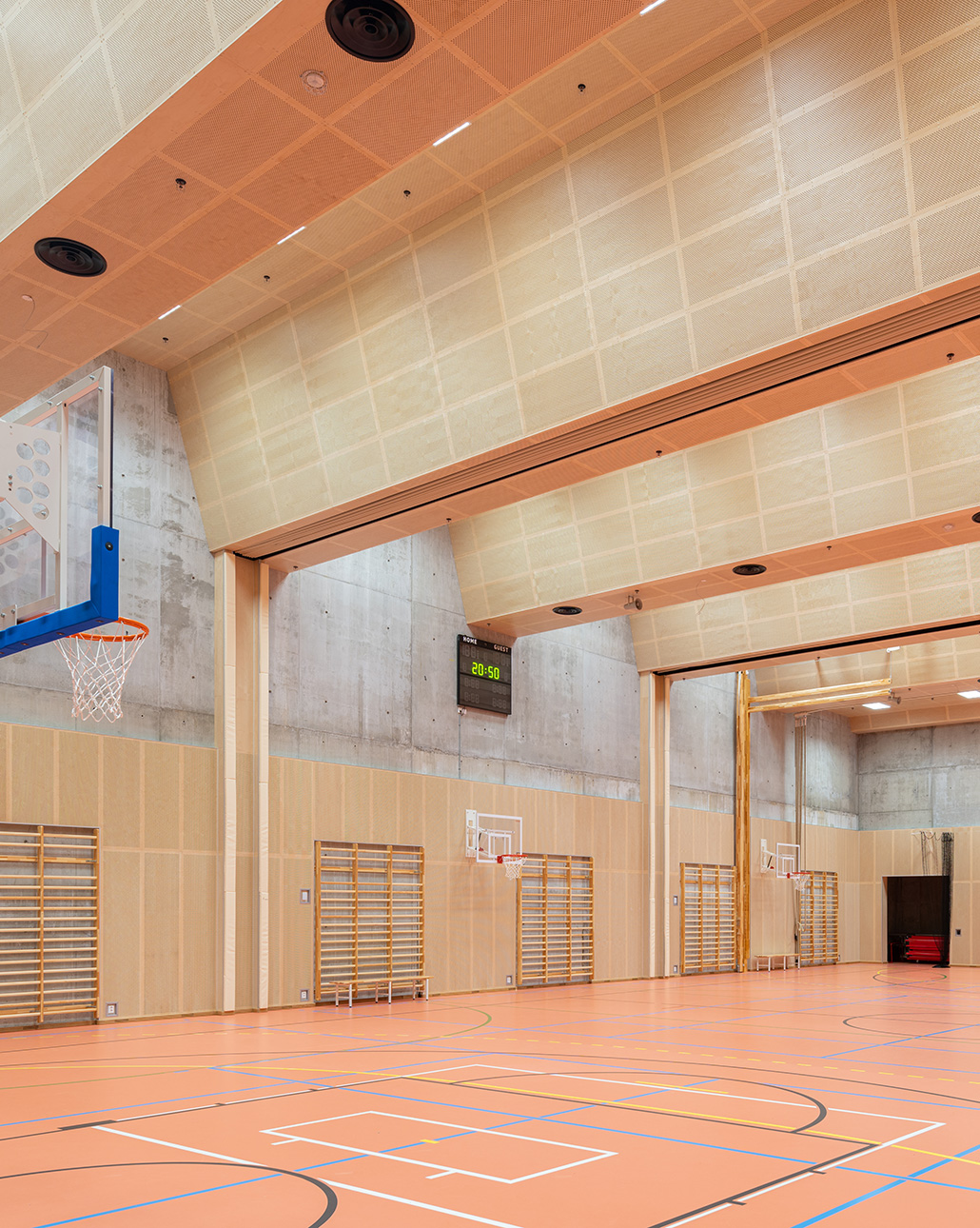
Sports halls
Acoustic performance and physical durability together
Hard parallel surfaces and high ceilings create long reverberation times that make PE sessions loud and exhausting — and make communication between teacher and students difficult. For wall surfaces where ball impact is likely, standard acoustic panels are not suitable.
Acoustic target
Significant RT reduction
Untreated sports halls commonly exceed 3 s RT. Class A ceiling treatment is the most efficient first intervention.
Fire class required
A2-s1,d0 or B
Confirm with Building Control. Both classifications available depending on product and jurisdiction.
Recommended products
EHIP panels are specifically designed for high-impact wall surfaces — acoustically effective, impact-resistant and available with A2-s1,d0 fire classification. Not a compromise product.
RETROFITTING
Retrofitting acoustic treatment in existing schools
Acoustic refurbishment of an existing school presents a different set of constraints to new build. Installation depth is limited by existing ceiling heights. Disruption to the school day must be minimised. Fire classification must be verified for the complete installed system including any existing substrate.
For ceiling retrofits with minimal depth, Gustafs Nano Panels are the most depth-efficient solution. For situations where a new substructure is impractical, Feltfon AddStyle clips directly onto an existing soft ceiling tile without additional mounting – making acoustic improvement possible with very limited disruption.
All Gustafs products are available with full fire reclassification documentation for retrofit projects where the existing substrate is unknown or unverified.
Products for education and learning spaces
Which Gustafs products are right for a school or university project?
Every product below achieves A2-s1,d0 fire classification unless noted. All are available with full acoustic data, fire classification documentation and Declaration of Performance.
Gustafs acoustic products – education and learning spaces
Which Gustafs product is right for my education project?
The table below gives you a direct overview of where each product can be used, what acoustic class it can achieve, its fire classification and what type of learning space it is best suited for.
| Product | Wall | Ceiling | Acoustic class | Fire class | Best for |
|---|---|---|---|---|---|
| Wood panels – perforated | |||||
| Perforated panels | x | x | A, B, D | A2-s1,d0 | Classrooms, corridors, libraries |
| Nano Panels 0.5 mm holes, invisible |
x | x | B, D | B-s1,d0 | Design-led walls, study spaces |
| EHIP panels Impact resistant |
x | A, B, D | A2-s1,d0 | Sports halls, high-traffic areas | |
| Bespoke panels Custom perforation patterns |
x | x | A, B, D | A2-s1,d0 | Music rooms, performance spaces |
| Wood – Linear Ribs | |||||
|
Rib-R /
Rib-S /
Rib-E /
Rib Narrow
Fibre-gypsum core
|
x | x | A, B, C, D | A2-s1,d0 | Atriums, corridors, feature ceilings |
| Blayde baffles 130–400 mm depth |
x | A, B, C, D | A2-s1,d0 | Lecture halls, high ceilings | |
| Linear Mix Ribs + Feltfon + Blayde + F-Line LED |
x | A, B, C, D | A2-s1,d0 / B-s1,d0 | Auditoriums, feature spaces | |
| Felt – Feltfon | |||||
| Feltfon Linear Rib rPET felt, linear design |
x | x | A | B-s1,d0 | Libraries, study areas, sports hall ceilings |
| Feltfon Baffles | x | x | A | B-s1,d0 | Libraries, study areas, sports hall ceilings |
|
Feltfon Diabolo /
Curves /
Pixel /
DNA
3D shapes
|
x | x | A | B-s1,d0 | Feature walls, atriums |
| Feltfon AddStyle Clips onto existing soft ceiling |
x | A, B, C | B-s1,d0 | Retrofit projects | |
Download
Proven in real educational projects
Has Gustafs been specified in schools and universities?
CASE STUDIE
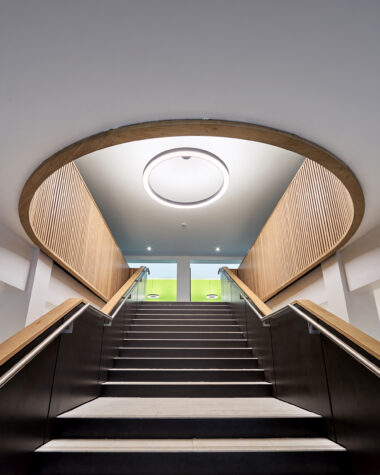
Radley College Science Block, Oxford
A full reconfiguration of the science facilities at one of the UK’s leading independent schools. Material quality, acoustic performance and fire classification all had to meet the demands of a high-specification educational environment. Gustafs panels were specified throughout, delivering natural wood surfaces with A2-s1,d0 fire classification.
ARCHITECTS: Gray Baynes + Shew Architects – Fiona Godlement
CASE STUDIE
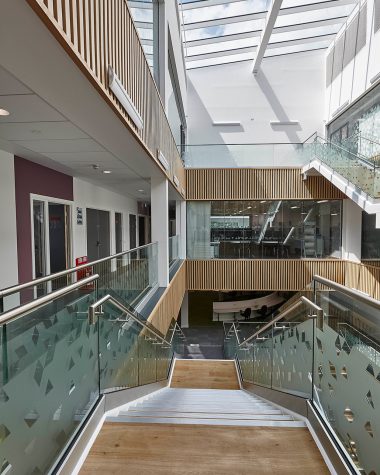
Torfaen Learning Zone, Wales
A £20 million purpose-built sixth form campus serving over 1,000 students. Gustafs, together with UK distributor LSA Project, developed a customised wooden slat solution for both ceilings and walls – providing biophilic feature surfaces with integrated acoustic performance across all five floors.
ARCHITECT: HLM Architects
CASE STUDIE
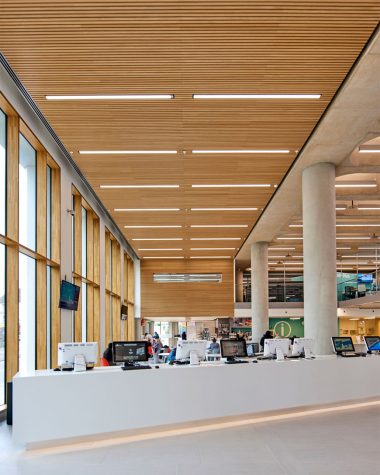
University of Bedfordshire Library
RIBA East Award 2018. Slatted wood panels specified throughout a new university library where acoustic quality and the warmth of natural materials were both central to the brief.
ARCHITECT: Associated Architects – Joe Belcher
CASE STUDIE
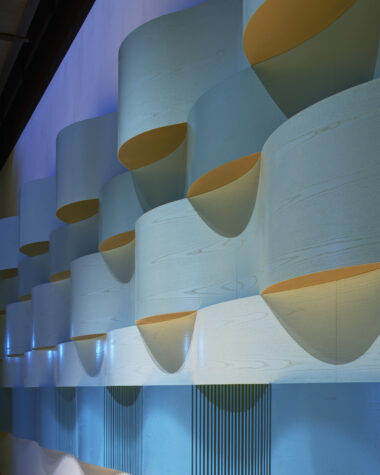
Royal College of Music, Stockholm
Four concert halls, each designed for a different acoustic character. Rehearsal rooms built as floating constructions with no structural contact to the building. Gustafs bespoke panels in painted ash veneer — red in the Royal Hall, blue in the Chamber Hall, black in the Black Box — each designed specifically for its acoustic brief by architect Annika Askerblom. One of the most acoustically ambitious music education buildings in Scandinavia.
ARCHITECT: AIX Arkitekter – Annika Askerblom
ACOUSTIC CONSULTANT: LN Akustikmiljö / Jan-Inge Gustafsson, Norconsult
CASE STUDIE
Una Marson Library, London
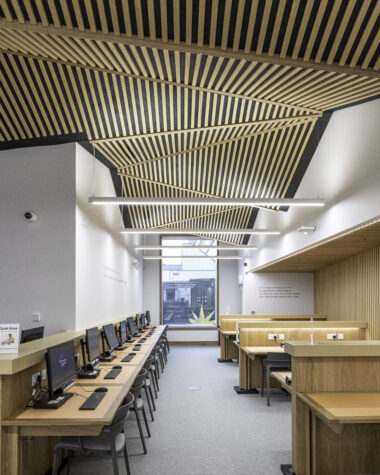
A bold ceiling design in a British public library where Gustafs Linear Ribs are installed in a diamond-shaped pattern – demonstrating how a standard product can create an exceptional architectural result.
ARCHITECTS: HTA Design – John Comer
CASE STUDIE
Lundby School, Gothenburg
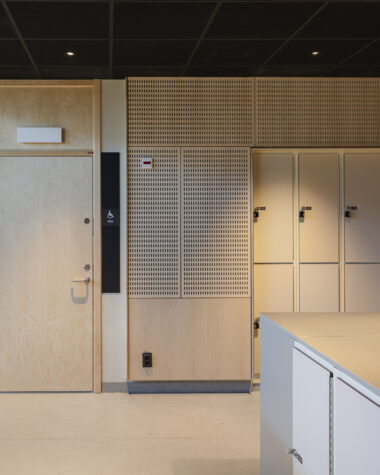
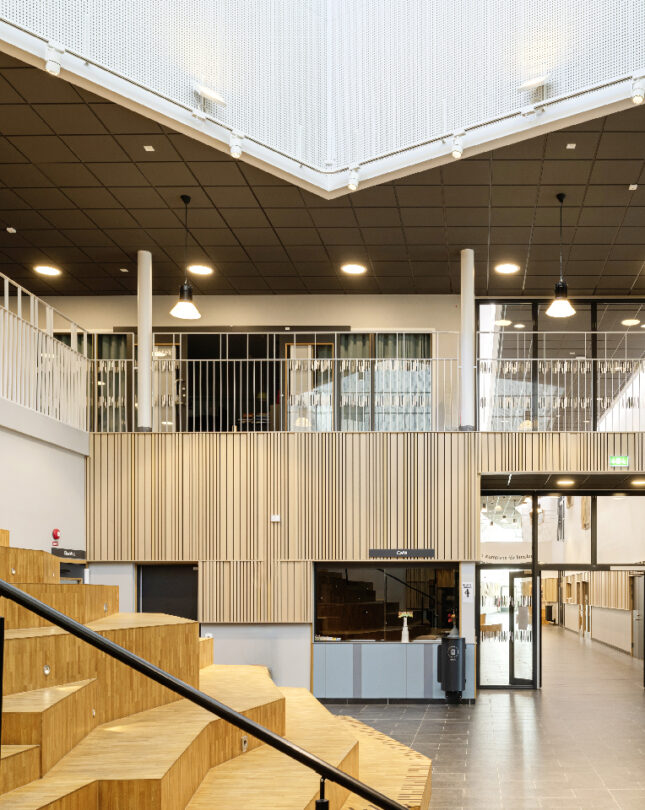
A new school for 630 students in grades 7–9 on Hisingen, Gothenburg – designed to function as an active community hub well beyond the school day. The design centres on safety, warmth and an environment where students can flourish. Natural materials including slate and wood shape a calm, harmonious interior. Gustafs contributed Linear Ribs, perforated acoustic panels and plain panels in white-pigmented birch veneer throughout. On the upper floors, Linear Ribs foiled in deep blue add contrast and visual rhythm to the corridors.
ARCHITECT: D Office Arkitekter
DOWNLOAD & QUESTIONS
Ready to specify your educational interior?
Whether you are at concept stage or preparing a full specification, we can support you with acoustic data, fire classification documentation, product samples and project-specific guidance.
ORDER ACOUSTIC SAMPLES
DOWNLOAD ACOUSTIC DATA
CONTACT GUSTAFS
Frequently asked questions
What fire classification is required in a school or university?
Educational buildings are regulated occupancies. In the UK, Building Regulations Part B requires A2-s1,d0 or better for walls and ceilings in most areas of schools and universities – particularly corridors, stairs and spaces where evacuation is complex. Across the EU, national building codes based on EN 13501-1 apply similar requirements. Gustafs Panel System, Linear Ribs, Blayde and Linear Mix all achieve A2-s1,d0 through fibre-gypsum core composition – not chemical treatment. See our Fire Safety solutions page for full guidance.
What reverberation time should a classroom have?
The recommended reverberation time for a standard primary school classroom is 0.4-0.6 seconds at mid-frequencies. Secondary school classrooms can accept slightly longer times up to 0.8 seconds. Music rooms, lecture halls and libraries each have different targets and these should be specified by an acoustician. Gustafs provides alpha-values for all products to support acoustic modelling.
Can wood panels be used in a school corridor?
Yes. Corridors in schools require A2-s1,d0 fire classification as primary evacuation routes, which rules out most standard wood products. Gustafs Panel System and Linear Ribs achieve A2-s1,d0 through fibre-gypsum core construction – not chemical treatment – making them suitable for corridors, stairwells and all regulated areas.
What is biophilic design and does it work in learning environments?
Biophilic design incorporates natural materials, daylight, natural forms and connections to the outdoor environment into interior spaces. Research shows consistent correlations between biophilic design elements and improved concentration, reduced stress and better cognitive performance in learning environments. Wood is the most practical natural material for walls and ceilings – warm, variable, durable and available with full fire and acoustic certification.
How do I specify acoustic panels for a music room?
Music rooms require specialist acoustic design. The target reverberation time and the balance of absorption and diffusion depend on the size of the room and its primary use – practice rooms, ensemble spaces and performance halls all have different requirements. Gustafs recommends involving a specialist acoustician from early in the design process. Gustafs bespoke panels and Linear Mix give the acoustician full control over absorption and diffusion zone by zone.
Are Gustafs panels suitable for sports halls?
Yes. For wall surfaces where ball impact is likely, Gustafs EHIP panels are specifically designed for the purpose – impact-resistant, acoustically effective and available with A2-s1,d0 fire classification. For ceilings, Gustafs Feltfon delivers class A absorption and is well suited to the acoustic demands of a sports hall. Both A2-s1,d0 and B-s1,d0 products are available depending on building requirements.
Can Gustafs panels be demounted when a school is refurbished?
Yes. All Gustafs solutions are available in fully demountable versions using the Capax system. Panels can be removed individually and reinstalled – either in the same location after refurbishment or in a new building. This supports sustainability certification and reduces whole-life cost.
Do Gustafs products comply with BREEAM and LEED requirements?
Yes. Gustafs products comply with BREEAM, LEED, BVB, Svanen and other leading building certification programmes. EPD documentation is available. Products are manufactured using 100% renewable energy with 94% recycled material content. Full documentation is available on request.